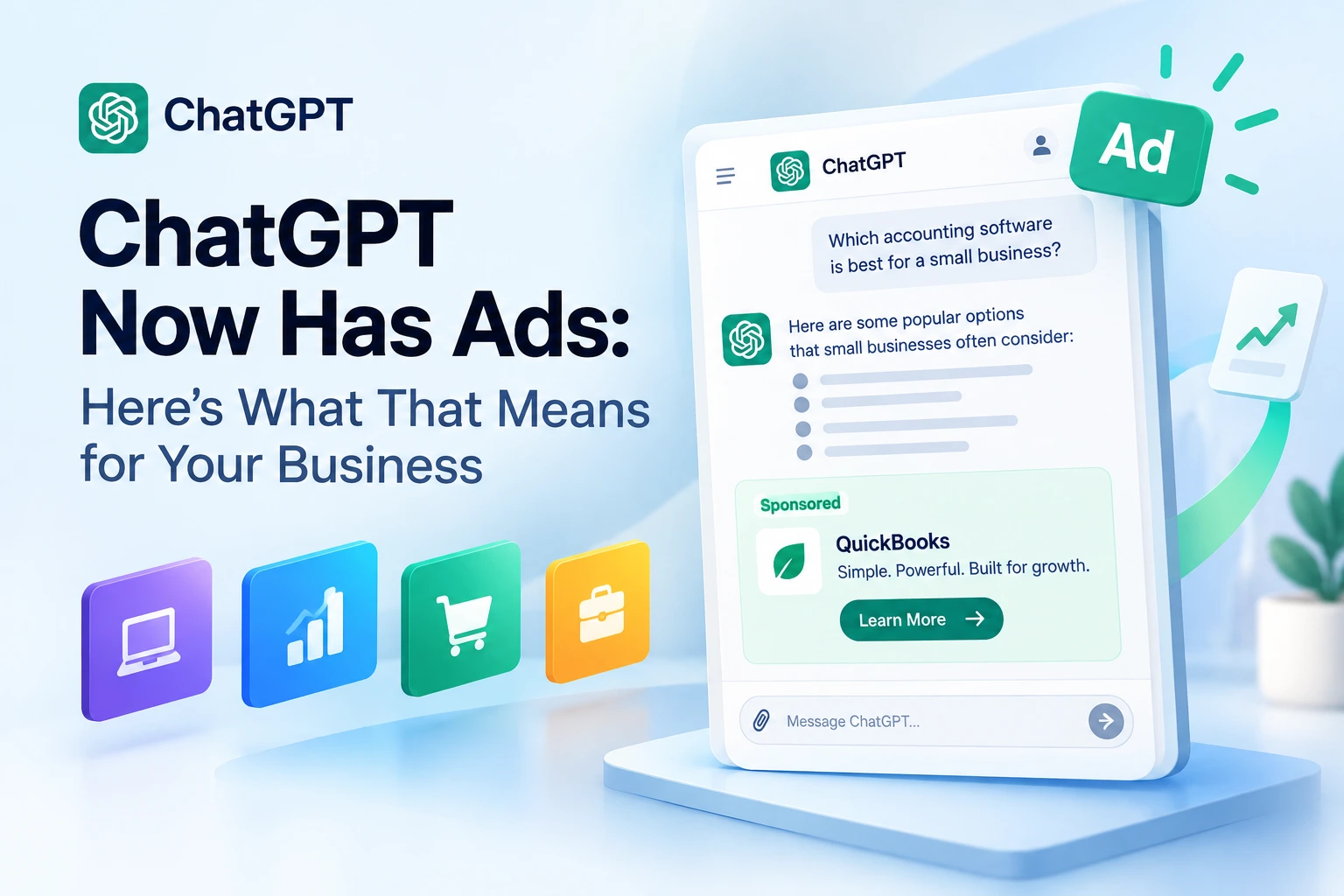
You’ve probably seen the headlines by now. ChatGPT has started showing ads. If you run a business and you’re wondering whether this actually changes anything for you, this post walks through it plainly, no jargon, just the practical stuff.
The News, Explained Simply
OpenAI has begun testing paid advertising inside ChatGPT, starting with users on the Free and Go plans, as confirmed in OpenAI’s own help center article on ads in ChatGPT. It’s a phased rollout, not a full switch-on everywhere at once, and OpenAI has been clear that it’s moving carefully so the product doesn’t start feeling like a normal ad-cluttered app.
This matters because ChatGPT isn’t a small experiment anymore. It’s a place hundreds of millions of people go to research decisions, compare options, and ask for recommendations, the same intent that used to live entirely inside a Google search box. Advertising inside that flow is a genuinely new channel, not just a feature update.
How These Ads Show Up Inside a Chat
When someone asks ChatGPT something like “which accounting software should a small business use” or “best CRM for a growing team,” they get a normal conversational answer. A sponsored card can then appear below that answer, clearly labelled, and separated from the AI’s own response.
The ad doesn’t influence what ChatGPT says. It runs on a completely separate system, matched to the topic of the conversation rather than a typed search term. Think of it as similar to Google Ads, except the moment it interrupts is a conversation, not a search results page, which is arguably a more engaged moment to catch someone’s attention.
Who’s In the Room to See Them
Ads show up for Free and Go plan users. Anyone paying for Plus, Pro, Business, Enterprise, or Edu doesn’t see them at all. Ads also stay away from sensitive conversations, personal health, mental health, or politics, by design.
Since the free tier covers the large majority of ChatGPT’s user base, the reach on offer here is significant, even though the ad product itself is still early.
Do You Need a Big Budget to Compete Here?
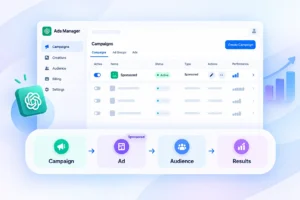
No, and this is the part most people get wrong. Early ad platforms tend to favour whoever spends the most, but the self-serve setup here means a business can start small, test, and learn before committing real budget. The bigger risk right now isn’t cost, it’s ignoring the channel until it’s crowded and expensive, the way most new ad platforms eventually become.
The Part Most Coverage Leaves Out
Here’s what most coverage of “ChatGPT ads” misses: paying for a placement is only one way to show up in ChatGPT. The other way is getting mentioned or cited for free, inside the actual answer, because your content is the source the model trusts.
These are the current changes in digital marketing. Search has split across Google, ChatGPT, and other AI tools, and each one decides differently who gets shown. This is where two newer disciplines matter:
- GEO (Generative Engine Optimization) — building content and brand authority so AI tools are more likely to cite or recommend your business directly inside an answer.
- AEO (Answer Engine Optimization) — structuring your content around the exact questions buyers ask, so an AI model can lift a clean, direct answer straight from your page.
An SEO company that’s still only reporting Google rankings is only covering half the job today. The businesses pulling ahead are combining classic SEO with GEO and AEO, so they show up whether someone Googles them or simply asks ChatGPT.
Is It Worth Acting on Today?
If your customers tend to research before they buy or get in touch, yes, it’s worth understanding this now rather than in a year, once every competitor has caught on and costs have climbed. The pattern repeats with every new channel: whoever moves early while competition is thin gets more attention for less spend and builds a lead that’s hard to close later.
That doesn’t mean throwing budget at ChatGPT ads blindly. It means running a small, structured test, while also fixing the more permanent problem: whether AI tools even know your business exists when nobody’s paying for the mention.
Where Digital Upward Comes In
This is exactly the gap most agencies aren’t covering yet. DigitalUpward works across classic SEO, GEO, and AEO as one connected approach rather than separate services bolted together. That means checking how a brand currently shows up (or doesn’t) inside AI-generated answers, fixing the content and entity gaps causing that silence, and helping decide where a paid ChatGPT test genuinely makes sense versus where organic AI visibility is the better long-term bet. For a business trying to figure out where to even start with this shift, that’s the actual work worth doing. You can see how this connected approach works on our SEO services page.
The Bottom Line
ChatGPT ads are a real, new channel worth testing early. But they’re only one half of the visibility question. The other half, whether your business gets mentioned for free when someone asks AI for a recommendation, is being decided right now by how seriously you take GEO and AEO alongside your regular digital marketing. Businesses sorting out both sides of that early will be the ones showing up. Everyone else will just be background noise in someone else’s answer.
Frequently Asked Questions
Does ChatGPT charge users to remove ads?
No extra charge is needed beyond an existing paid plan. Anyone on Plus, Pro, Business, Enterprise, or Edu already sees zero ads. Free and Go plan users can also switch to an ads-free browsing mode with lower usage limits.
Can a business pay ChatGPT to change what it recommends?
No. The ad system runs on a separate layer from the model generating answers, so a paid placement cannot alter or influence the actual response a user receives.
How is ChatGPT deciding which ad to show me?
The system looks at the context of the current conversation, along with rough signals like location or language, and, if the user has allowed it, some history from past chats. It does not use the same keyword-bidding model that Google Ads relies on.
Do small businesses need a big budget to test ChatGPT ads?
No. The setup is self-serve, which means a business can start with a small test budget and scale up only if the results justify it, rather than needing a large spend upfront.
 ChatGPT Now Has Ads: Here's What That Means for Your Business
 Why Local Customers Need More Than a Google Ranking
 Why Website Architecture Matters More Than Visual Design
 The Search-to-Sales Gap: What Delhi Businesses Should Fix Before Spending More on Digital Marketing
 Beyond Launch: How to Build a Website That Keeps Improving After Go-Live