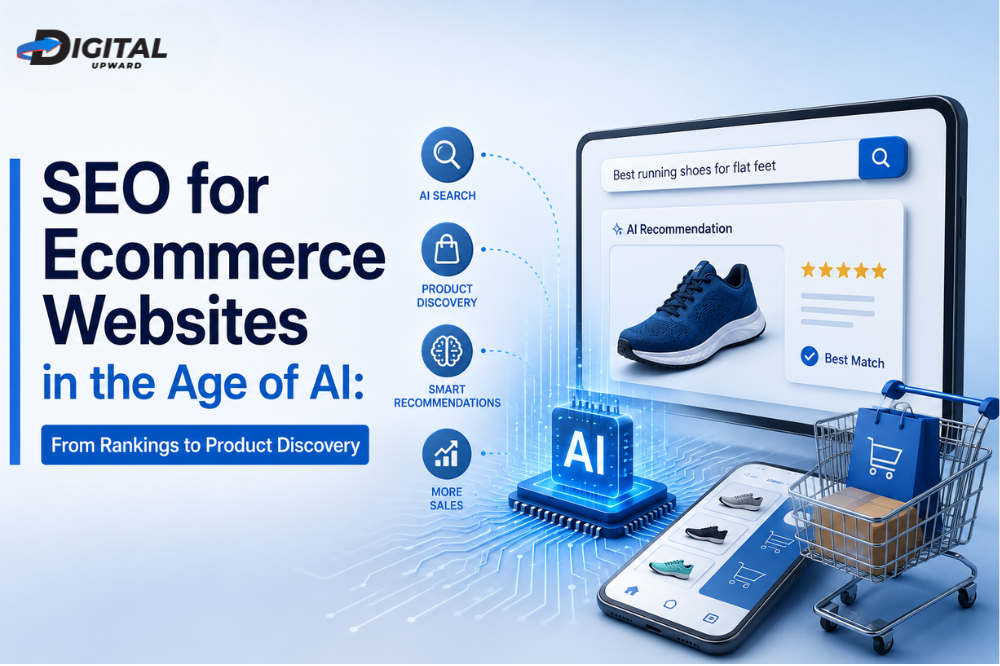
The domain of search in e-commerce is rapidly developing. The customer is not just looking for something within the search results of Google. They may be comparing products on marketplace sites, viewing videos, reading reviews, utilizing social media or even asking an AI-based technology for advice before buying the product.
It means that seo for ecommerce websites does not only include the ranking of the product and category pages in Google. It is vital for e-commerce businesses to make sure that their products can be easily discovered, understood and analyzed by both traditional and AI search.
Google has launched many features of AI search like AI Overviews and AI Mode, where one can ask long questions. This opens up a new possibility for ecommerce enterprises to optimise for product discovery as well as rankings.
How AI is Changing eCommerce Search
Traditional ecommerce SEO often follows a typical path: find keywords, optimise pages, increase ranks and generate organic traffic. Those principles are still crucial, but the search trip is getting more complicated.
A shopper looking for “best running shoes for flat feet under 8000 rupees.” Instead of visiting multiple websites the consumer can ask an AI system to find acceptable products, assess the qualities of the products and explain which of the possibilities satisfy particular needs.
Google is also building AI-driven shopping experiences with rich product information. Ecommerce website SEO is a little more complicated than just keyword placement. Product information must be clear, structured and consistent so that search engines and artificial intelligence systems can grasp what a product delivers, who it is suitable for and how it compares with alternatives.
Product Data Is Becoming an SEO Asset
Product data is one of the most ignored aspects of seo for ecommerce websites.
An ecommerce website can have thousands of products, but visibility can suffer when product names are imprecise, specs are insufficient, variants are poorly arranged or crucial information is only available inside photographs.
A better strategy is to treat product information as an SEO asset.
For example, a laptop site should clearly state what kind of processor, RAM, storage, display, operating system, weight, connectivity and warranty it has. This helps people to make decisions and gives more information to search engines to match products to specific queries.
Effective ecommerce SEO services increasingly mix technical SEO, product information, structured data, internal linking and content strategy rather than dealing with these operations independently.
AI SEO, AEO and GEO are growing search visibility
AI is developing new ways of search optimisation. AI SEO is optimising material and information to be discovered by AI. AEO or Answer Engine Optimisation is optimising information to be used in direct answers.
GEO (or Generative Engine Optimisation) is the process of generative artificial intelligence systems finding, understanding and citing information from different sources.
For online organisations, these tactics open up potential beyond traditional rankings. Even if a customer does not follow a standard search-result route, a product may nevertheless potentially appear within an AI-generated recommendation.
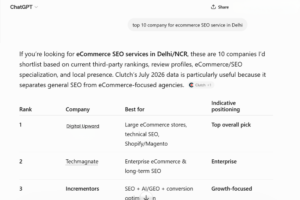
Technical SEO Is Still Important
AI search doesn’t make technical SEO less significant. Strong technological fundamentals are still important for ecommerce search optimization.
Search engines need to be able to crawl and read ecommerce websites properly. Things like clean URL structures, mobile usability, rapid loading times, canonical tags, XML sitemaps and accurate structured data still matter.
Faceted navigation is very crucial for large retail websites. Filters can create thousands of URLs, many of which have little unique value. Controlling these URLs allows search engines to concentrate on key product and category pages.
What Modern Ecommerce SEO Strategies Get Wrong
Keywords, backlinks, metadata, and rankings continue to drive many SEO efforts. These are still useful but the rising opportunity is to combine product data, search intent, AI discoverability and commercial consequences.
Reviews, product feeds, product specs and consistent retailer information can all help products be understood across current search experiences.
Measurement also must change. Rankings alone don’t tell if an ecommerce approach is driving real growth.
Businesses should analyse organic revenue, non-brand traffic, product page interaction, conversions, indexed products and search impressions. Where possible, they should also be monitoring visibility within AI-powered search experiences.
The goal should be to expand the firm, not to rank higher on a report.
Digital Upward’s Ecommerce SEO Methodology
Digital Upward is a seo company in Delhi NCR. They handle ecommerce SEO by bridging the old optimisation with the evolving search economy. Its strategy includes ecommerce SEO, product and category optimisation, AI SEO, AEO and GEO to make ecommerce websites easier for search engines and AI-powered systems to understand. The focus is on good content, robust website architecture, accurate product information, and continuous organic growth, not exaggerated ranking guarantees.
Future of SEO for eCommerce Websites
SEO for ecommerce websites will not replace traditional SEO in the future. Instead it will extend what SEO implies.
Technical accessibility, meaningful material, structured data, internal connectivity and authority will still be the basis. AI will add another layer by changing how people ask queries and how things are found.
The pragmatic response for ecommerce firms is not to give up on traditional SEO. It is to build upon it.
Businesses should get the product information right, the pages technically accessible, the material really useful and the product distinctions simple to understand. They also need to evaluate how their information can be understood by standard artificial intelligence systems and answer engines.
FAQs
How AI is aiding SEO?
Artificial intelligence may assist SEO teams understand search intent, spot content shortages, manage big product inventories and streamline content workflows. In ecommerce it can also help understand product qualities and changing search behaviour. However, AI should support, not replace, human strategy.
Does traditional SEO still matter for ecommerce?
Yes. Technical SEO, meaningful content, internal linking, structured data and website performance are vital. A strong SEO foundation is critical as AI-powered search still draws from the information that is available across the web.
What’s the difference between ecommerce SEO and GEO?
Ecommerce SEO is mostly focused on enhancing visibility in search engines and shopping results. GEO is all about increasing the likelihood of being found, understood or referenced by generative artificial intelligence systems. Both can be combined as part of a modern search strategy.
 Digital Marketing Agency for Education: Building a Better Student Acquisition Strategy
 ChatGPT Now Has Ads: Here's What That Means for Your Business
 Why Local Customers Need More Than a Google Ranking
 Why Website Architecture Matters More Than Visual Design
 The Search-to-Sales Gap: What Delhi Businesses Should Fix Before Spending More on Digital Marketing