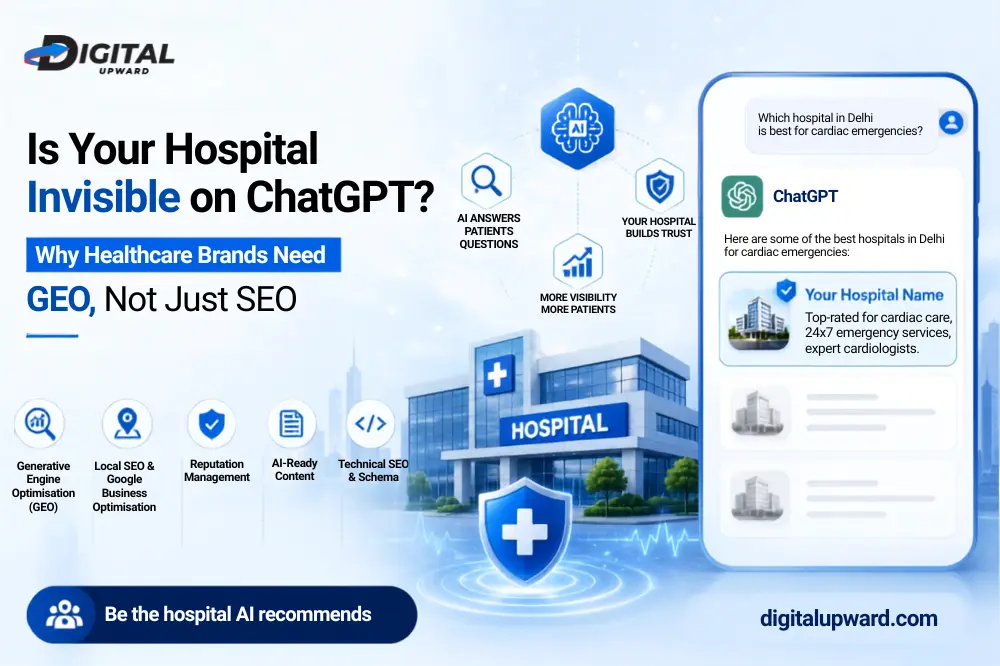
Imagine a patient in Delhi feeling chest tightness late at night. Instead of calling a doctor, she opens ChatGPT and types: “Which hospital in Delhi is best for cardiac emergencies?” Within seconds, she gets a clear answer, a few hospital names, a short reason for each, and nothing else to scroll through.
If your hospital was not one of those names in that answer, she did not even consider you. Not because your doctors are less skilled, but simply because you weren’t included in the conversation. This is the new face of healthcare search in India, which is precisely why more hospitals, clinics and diagnostic centres are revisiting their perspective on investing in a digital marketing service.
The Shift Nobody Warned You About
For years “getting found online” was one simple thing: rank on Google. Patients today are increasingly avoiding the list of blue links altogether. They are firing conversational, question-based queries directly to ChatGPT, Gemini, Perplexity and Google’s AI Overviews, and doing what answer is returned.
Today, it happens that tens of millions seek AI tools to ask health-related questions every day around the world and often out of regular hours when no real doctor is available. This is finding fertile ground in India with hundreds of millions of smartphone owners, a burgeoning digital health ecosystem built around the Ayushman Bharat Digital Mission, and an already tech-savvy patient population knowing how to book appointments/check reports/read reviews online.
The result? The hospital has the best doctors, great infrastructure modern website, but is completely invisible from the only place where more and more patients go first.
SEO Got You Ranked. It Won’t Get You Recommended.
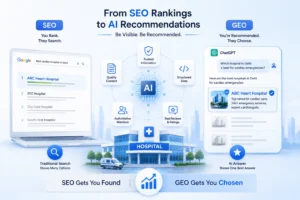
This is the point where many healthcare marketing plans fail. Standard SEO is about keywords, backlinks, and page speed, all still relevant, but written for a world in which search engines simply give patients a list of options to compare.
AI tools do not simply distribute a list. They say a name and pronounce with conviction. The method of designing your hospital’s online presence so that AI systems will select you to bring up is known as Generative Engine Optimisation or GEO. It’s a relatively new field, and therefore (unlike SEO) you are in a much less saturated space, making this an area where hospitals that act now have an honest competitive advantage – which an experienced digital marketing agency for healthcare can help you forge the right way from day one.
And this is the part that most guides on this subject fail to cover: GEO does not replace local SEO, it complements it. Today, search engines analyze “near me” searches separately from broad health inquiries. Even if someone types “best dentist near me” they are much more likely to see a traditional local result and Google Maps listing than an AI-based summary. But if they ask a broader question such as “how is a root canal performed” or even “knee pain which treatment,” nowadays AI answers almost always win. That means hospitals have to approach dual, local listings for hyperlocal patients and AI-citable content for millions of health-related queries being made.
Why Being Well-Known Isn’t Enough Anymore
Interestingly, even big hospital brands that are well positioned and mentioned often from AI tools have subsequently seen their website traffic decline. Just because they are cited by an AI does not mean the patient clicks through, unless the AI already answered their question.
But here is the relevant trade off: hospitals that never appear are losing the patient entirely before any decision was made. Even if they do not click on your citation, you are still front of the patient and building future recognition for when they need care. Invisible means you never stood a chance.
What Actually Makes AI Recommend Your Hospital
AI systems depend on a few practical signals:
- Genuinely useful content: A clear page explaining conditions, treatment options, timers for recovery and costs that are written as the patient would question not generic marketing copy.
- Verifiable trust markers: Accreditation details (NABH, JCI), doctor qualifications, and actual patient outcomes
- Structured data: Technical tags (schema markup) that tell AI exactly what your hospital has, and where
- External References: Appearances in health directories and medical publications along with government or academic sources to support your credibility
And none of these are accidental actions. They are the exact same kind of planning already applied to SEO, content, and reputation management by a well-run digital marketing service, but that has now been extended out across an additional set of platforms.
How Digital Upward Helps Healthcare Brands Get AI-Ready
Digital Upward is here to tackle that very challenge for healthcare brands. As a digital marketing service that works with hospitals, clinics and diagnostic centres, we create what AI systems are looking for — content the patient is actually searching for which provides real answers to real questions, technical SEO and schema markup in order to make your site readable by AI, optimised local SEO together with Google Business Profile listing anything even close to “near me”, along with reputation management keeping top quality reviews coming in over time.
Being an SEO agency for healthcare, we do not consider GEO as a separate entity, we embed it into the same strategy alongside your traditional rankings to ensure your hospital appears when a patient scrolls Google or even asks ChatGPT. And it’s not just about more traffic, it’s getting your hospital to be the one that AI is willing to say out loud.
Where to Start
You don’t have to change everything at once. Begin with three steps:
- Check your current visibility. Ask ChatGPT and Gemini the same questions your patients would ask. See how your hospital comes up
- Audit your foundations. Is your Google Business Profile all filled out? Are your reviews from actual and timely patients? Does your website help patient enquiries in plain language?
- Build deliberately, not randomly. Combine an agency that understands the old fashioned rankings with the new AI-powered visibility, they need to work together, no against each other anymore
The hospitals that begin to build this authority today will be the same hospitals AI systems are recommending a year from now. Those that wait will pay through the nose down the road, to play catchup with a lead someone else already established.
Your patients are already changing the way they search. The only question left is whether your hospital keeps pace as well.
 Digital Marketing Agency for Education: Building a Better Student Acquisition Strategy
 ChatGPT Now Has Ads: Here's What That Means for Your Business
 Why Local Customers Need More Than a Google Ranking
 Why Website Architecture Matters More Than Visual Design
 The Search-to-Sales Gap: What Delhi Businesses Should Fix Before Spending More on Digital Marketing